
Catalog of technical garments and accesories
online products
We develop customized product catalogs for manufacturers, distributors, and B2B companies that need to organize, showcase, and position their offerings online.
From simple catalogs to platforms with thousands of products,
advanced filters, technical specifications and integrations with your systems.





Functional, organized, always available
What is an online product catalog?
It is a web platform that allows you to organize and display products using categories, filters, search engines and individual listings, without the need to incorporate a complete online purchase process.
It is ideal for manufacturers, distributors, and B2B companies where the customer needs to consult information, compare specifications, download documentation, or request a quote before making a decision.
Organize your catalog to suit your business needs
Categories
Organize your products
according to the lines, families or divisions of your business.
subcategories
Create different levels for
structure extensive catalogs
or specialized.
Filters
It allows you to search by size,
material, capacity, brand or
any technical attribute.
Search
Find products by
name, SKU, model or internal code.
Documents and technical specifications
Integrates PDFs, manuals,
certificates and documentation
downloadable.
Individual cards
Present each product with
description, specifications,
images and calls to action.
Videos
Add demonstrations,
installations, tutorials or
technical content.
Does your catalog need
Anything else?



Visibility that generates business
Each product can become a search opportunity
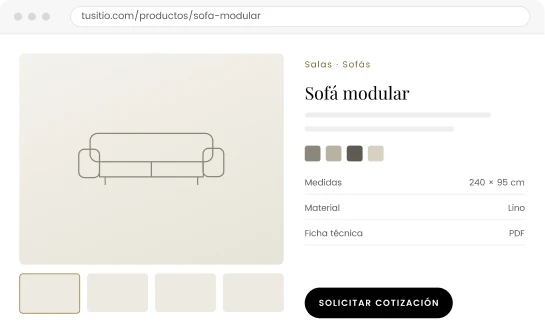
Each listing can have its own URL and specific content so that customers and search engines understand what product you offer and what its features are.
A well-structured architecture allows products, categories, and families to be indexed individually and respond to increasingly specific searches.
Own URL
A separate and easy-to-share address for each product
Specifications
Attributes and technical data
organized for consultation
Gallery
Product images, views, and visual resources
Call to action
Quote, contact, download or the
action that the process requires
Own URL
A separate and easy-to-share address for each product
Specifications
Attributes and technical data
organized for consultation
Gallery
Product images, views, and visual resources
Call to action
Quote, contact, download or the
action that the process requires
More indexable products mean more opportunities to appear in
specific searches, provided that each record has useful, accessible content and
properly optimized.


A business tool
Your catalog doesn't just show products,
generates business opportunities
We design each interaction to make it easy for a user to go from looking at a product to starting a conversation with your company.

Request Quote
The user can request
product information
that he is consulting.

Chat on WhatsApp*
Start a conversation with your
sales team from a
specific sheet.

Download information
Allows access to records
techniques, documentation, certificates or manuals.

Contact form
Each request may
automatically identify
the product of interest.
Connect with your customers via WhatsApp from any listing, with automated support through a bot or directly with your sales team.


Manage your content
A catalog that your team can manage
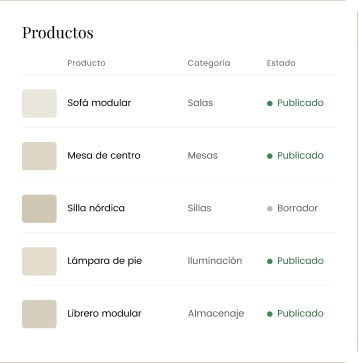
Your company shouldn't have to rely on a developer every time you need to update a product. We create a manageable platform and train your team to keep the information up to date.
add products
Create new listings as your catalog grows
Update information
Modify descriptions, specifications, images, and documents
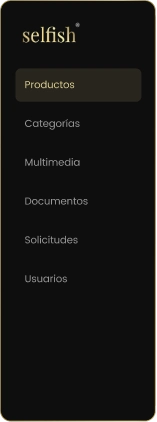
Organize categories
Manage lines, families, and classifications
We train your team
We'll teach you how to use the platform so you can keep your catalog up to date
Connect with your ecosystem
Your catalog can be part of your operation
We can connect your catalog with the platforms your company uses to keep information and processes synchronized.
From automated imports to custom integrations, we can connect the catalog with internal systems or third-party platforms that allow integration via API.

ERP

CRM

Inventories

APIs

Databases
Import of products
Upload information from other platforms or structured files.
Automatic stock update
Maintain synchronized availability when the project requires it.
Price synchronization
Update business data from a central source.
We work on integrations with platforms like Odoo and with custom systems.
Case Studies
Different catalogs for
different businesses
We don't start from a rigid format. We design the catalog architecture according to the products, information, and business process of each company.
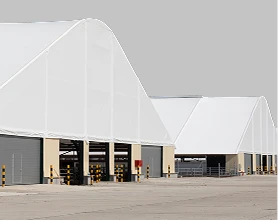
Compact catalog
Raylo
Products organized for easy and direct consultation.

Specialized catalog
Nat-Mac
Product architecture, categories, and technical information.

extensive catalog
Nile Marble and Granite
Visual organization of materials, products, and applications.

Specialized architecture
Once Solutions
Individual solutions related to categories and content

Make the best decision
Do you need a catalog or an ecommerce site?
Both solutions can organize products. The difference
The main focus is on the process that the user must perform.
Not sure which one your company needs?
We can help you define the most suitable solution according to your business process.



FAQS
FAQ
1 How many products can an online catalog have?
We don't work with a predetermined limit. The architecture, search engine, filters, and administration are designed according to the quantity and complexity of your products.
2 Can I update the products myself?
Yes. We can create a manageable catalog so your team can add products and update descriptions, specifications, images, documents, and categories. We also provide training on how to use it.
3 Can every product appear on Google?
Each product can have its own URL and content so that search engines can understand and index it. Ranking also depends on content quality, technical architecture, competition, and SEO strategy.
4Can the catalog include technical specifications and downloadable files?
Yes. Each product can integrate PDFs, manuals, certificates, safety data sheets, specifications, videos, and other relevant resources.
5Can I request a quote from a product?
Yes. We can incorporate forms, WhatsApp, or other calls to action that automatically identify the product being viewed.
6Can the catalog connect to my ERP, CRM, or inventory system?
Yes, provided the platform allows integration and there is an API or a viable data exchange mechanism. The scope is evaluated for each project.
7Is it possible to convert the catalog into an ecommerce platform later on?
In many cases, yes. It's advisable to consider this possibility from the planning stage to define a technological foundation and structure that allow for orderly growth.
8How long does it take to develop a catalog?
It depends on the number of products, the organization of the information, the features, the integrations, and the state of the content. Once we understand the scope, we can define a realistic timeline.
9What do I need to get started?
An idea of the number and type of products, their categories, the available information, and the process you want the user to follow. If the information is not yet organized, we can help you define the structure.