UX design continues to evolve toward simpler, more personalized digital experiences focused on users' real needs. By 2026, brands are moving away from cluttered interfaces and toward faster, more immersive, and easier-to-use websites .

User experience is no longer solely about a website's appearance. Speed, navigation, typography, micro-interactions, and personalization all have a direct impact on how users perceive a brand and make purchasing decisions.
For online stores , keeping up with new UX design trends can make a significant difference in conversion, customer retention, and brand perception.
These are six of the top UX trends that are defining ecommerce in 2026.
Top UX trends for 2026
- Slower and more focused navigation
- Smooth, high-performance web experiences
- Digital interfaces with more texture
- Analog-inspired design
- Artificial intelligence focused on reducing friction
- Variable and optimized typefaces
Over the past few years, many websites have ended up adopting very similar structures, fonts, and visual styles.
Sara Mote and Rembrandt Van der Mijnsbrugge, co-founders of the design agency Mote, point out that this homogeneity is driving brands to seek digital experiences with a much more distinctive identity.
The goal is no longer to incorporate features simply because they are fashionable, but to design each element intentionally.
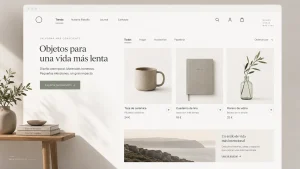
1. More leisurely and focused navigation
The internet is often associated with speed, immediacy, and a virtually endless amount of content. However, one of the most interesting UX trends for 2026 proposes precisely the opposite: reducing stimuli.
Slow browsing aims to simplify the digital experience so that users can focus on what is truly important.
In ecommerce, this means reducing unnecessary elements, limiting pop-ups, avoiding cluttered interfaces, and allowing products to have greater visual prominence.
Instead of presenting the user with multiple carousels, messages, promotions, and calls to action at the same time, the design seeks to create more natural journeys.
Sara Mote describes this trend as a response to the ecommerce model based on constant stimulation, infinite scrolling, and the accumulation of features.
For an online store, applying this philosophy can translate into:
- More white space around the products.
- A clearer visual hierarchy.
- Fewer simultaneous decisions.
- Interfaces with fewer distractions.
- Easier navigation between categories and products.
The result is a calmer, clearer, and more focused experience when making a purchase decision.
2. Smooth, high-performance web experiences
Website performance has become a fundamental part of the user experience.
A fast, responsive, and smooth website immediately conveys a greater sense of quality. Conversely, minor issues such as images that take a long time to load, buttons that are slow to respond, or clunky menus can negatively impact a brand's image.
Therefore, one of the main focuses of UX design in 2026 will be to create digital experiences where every interaction feels immediate and natural.
This includes paying special attention to so-called micro-interactions: small interface behaviors that appear when a user opens a menu, selects an option, hovers the cursor over an item, or performs an action.
Performance can even become an element associated with premium brands.
Instead of adding more and more features, many digital experiences are choosing to reduce the number of elements and significantly improve the quality of those that remain.
A good UX experience should feel fast without the user having to think about it.
3. Digital interfaces with more texture
For years, much of digital design was dominated by extremely clean, flat, and polished interfaces.
Now a different visual direction begins to emerge.
UX and UI designers are incorporating textures, grain, gradients, and subtle visual effects to create warmer, more tactile interfaces.
The intention is not to saturate the design, but to prevent digital experiences from feeling too sterile.
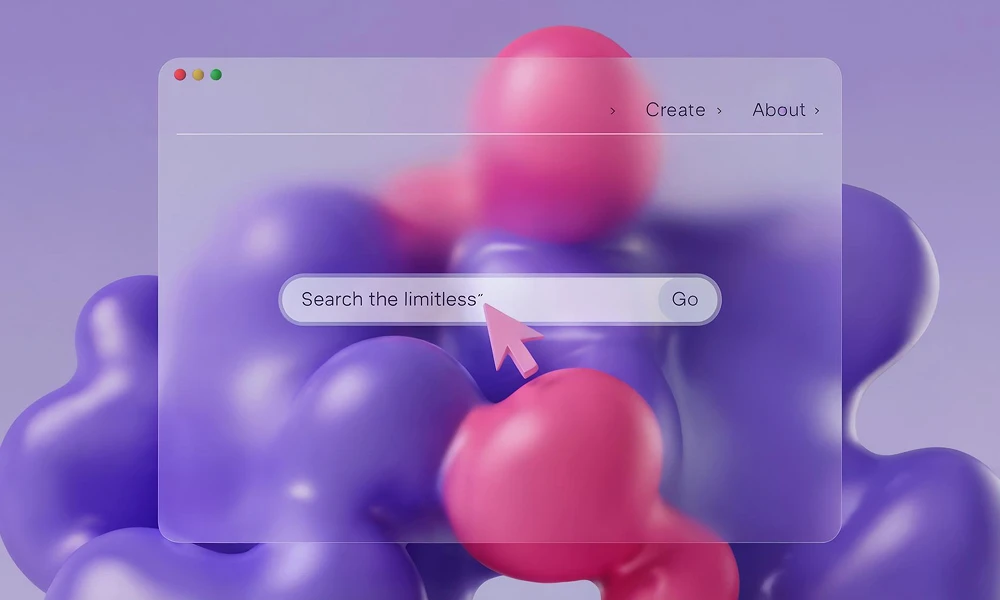
One of the techniques that is gaining popularity is the use of blur combined with noise or grain.
By incorporating small variations in texture onto blurred surfaces, it is possible to generate greater depth and a much more organic visual feel.
This resource can also help reduce visual problems such as banding , which occurs when a digital gradient shows visible stripes between colors instead of a completely smooth transition.
The trend towards more touch-oriented interfaces is also related to recent proposals such as Apple's Liquid Glass, which have once again put transparency and blur effects at the center of many conversations about UI design.
4. Analog-inspired design
As technology allows for the creation of increasingly perfect interfaces, there is also growing interest in recovering certain imperfections.
Paper textures, film-like photography, slightly worn colors, grain, editorial references, and other resources inspired by physical media are making a comeback in web design.
This trend reflects a search for more human and emotional experiences.
Analog elements can generate feelings of nostalgia and familiarity, even when used to introduce a completely new brand.
It's similar to what happens with the characteristic sound of a vinyl record, a cassette tape, or a photograph taken with film.
Those kinds of imperfections can contribute to visual identity.

In website design, this aesthetic can be conveyed through:
- Photographs with cinematic treatment.
- Textured gradients.
- Digital grain.
- Typefaces with editorial personality.
- Colors inspired by printing.
- Less mechanical animations.
- Elements that resemble physical materials.
For brands, it can be an excellent way to differentiate themselves from overly polished digital interfaces.
5. Artificial intelligence that reduces friction
Artificial intelligence will continue to have an important presence in digital experiences, but its true value will not necessarily lie in making it visible that a site uses AI.
One of the main UX trends will be to use artificial intelligence in a virtually invisible way to simplify the user journey.
Many brands are incorporating AI-based tools simply to add functionality. The problem arises when these features add more steps, decisions, or complexity.
From a user experience perspective, AI is much more useful when it eliminates work.
For example, it can be used for:
- Show relevant products automatically.
- Improve the results of the internal search engine.
- Better understand search intent.
- Create personalized recommendations.
- Filter very large catalogs.
- Adapting certain content to user behavior.
A store with thousands of products could use artificial intelligence to turn a complex search into a much smaller and more relevant selection.
The user does not necessarily need to know that there is an algorithm behind the process.
The important thing is that you find what you're looking for faster.
This approach will likely be one of the keys to ecommerce personalization in the coming years.
6. Variable and performance-optimized fonts
Typography is also evolving along with the new needs of digital design.
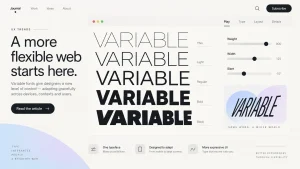
Variable fonts allow you to store different thicknesses, widths, and styles within the same font file.
This gives designers greater visual freedom and, at the same time, can help optimize a page's performance.
Instead of loading numerous separate files for each variant of a font, a variable typeface can centralize different configurations.
But the possibilities don't end there.
They also allow you to generate small typographic animations.
For example, text could smoothly transition from regular to italic, modify its weight, or slightly change its width as part of an interaction.
This type of micro-animation allows you to create moments of surprise and personality without introducing overly heavy elements into the interface.
However, typographic creativity must always be accompanied by legibility.
Brands need to ensure their text is easy to read on different screen sizes, resolutions, and settings, including dark mode.
Where is UX design headed?
UX design trends for 2026 show a major shift in how we understand digital experiences.
For a long time, innovation meant adding new features, animations, and elements to a page.
Now the trend seems to be moving in another direction.
The best digital experiences seek to eliminate noise, reduce friction, and use technology in a much more intentional way.
Speed, personalization, touch interfaces, analog references, and improved implementation of artificial intelligence will coexist within increasingly refined experiences.
For ecommerce brands, this means that good UX design is not simply about following visual trends.
It's about understanding how users navigate, reducing the barriers they encounter during their journey, and building a digital experience consistent with the brand's personality.
In 2026, standing out will likely depend less on having more features and much more on knowing how to choose which ones truly improve the experience.
Original article by Shopify | June, 2026